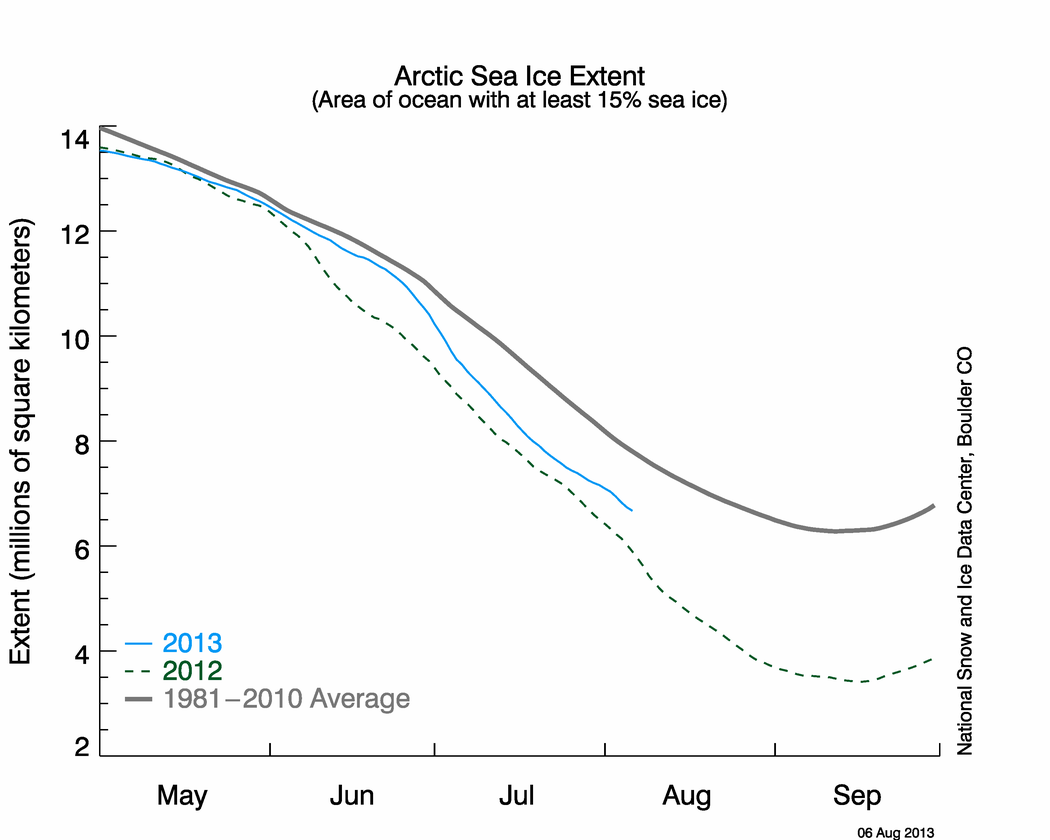
So, starting to be time to assess our various guesses. William Connolley and I made our 50 quatloo wager on over (his side) or under 5.38 million km^2 for the September average. The minimum, if we have indeed seen the minimum, is about 5.1 million. That looks favorable for my side of the bet. Though it would mean I definitely missed the September average, as I said that would be 4.92. More about that in a moment. The figure below suggests that since the extent dropped below 5.38 right about the start of September, I should be safe. Usually (see the climatological curve) the pack doesn't gain much area in September. But William could still win if we have an unusual last two weeks and the ice pack gains a lot of extent.

I've added a few lines to the NSIDC graphic of 12 September. One is the vertical line, to highlight when it is we dropped blow the climatological minimum. We've been below normal since early August. That in itself suggests a climate change. We're now about 3 standard deviations below the climatological minimum, which again, in such a short record, suggests a climate change. The significance of the extra large amount of ocean being exposed to the atmosphere, for an extra long time, is that it lets more ocean absorb more heat from the sun. Though this year looks to be a higher extent than 2007 and 2008, it's still below any year except 2007 and 2008. If we didn't know about those two years, we'd be surprised by this year being so low -- the 2005 September average extent (record before 2007) was 5.57 million km^2 -- far higher than this year is liable to average.
Still early to decide whether I owe William, or vice versa. Both of us will win our bets with Alastair. Looking down to the poll that I invited you to answer back in June, I'll say that the people who called for 7.5 million (the previous climatology) and 6.0 million km^2 are wrong. Also the 1 who went for 3, the 2 who went for 3.5, and the 4 who went for 4 million km^2 for the month's average. The 12 who went for 4.5 (which means anything in the range 4.25 to 4.75) should be pulling for a really massive storm to hit the western Arctic and obliterate huge amounts of ice extent. The main candidates are the 3 who went for 5, and the 1 who went for 5.5 (ranges of 4.75 to 5.25, and 5.25 to 5.75, respectively).
Something else this brings up (or at least this plus some comments I saw at a different site) is "How do you judge the quality of predictions?" I'll be coming back to this, using the Sea Ice Outlook estimates for my illustrations.